
Asian composite bows, also known as reflex bows, horsebows, and hornbows, come with many names and forms. However, their fundamental construction and function are unified by a unique and fascinating principle.
Who used these bows? Why are they different from other types of bows? How are they made?
The most famous and skilled archers of these bows were the Turkic and Mongol tribes led by the mighty Genghis Khan. For them, the rider, bow, and horse were inseparable. Bows based on the same design were also used by various cultures, including the Turks, Arabs, Persians, Mughals, Koreans, Chinese, Manchu, Egyptians, Scythians, Assyrians, and Huns. These bows were used from antiquity into the late Middle Ages, spanning a vast area from Eastern Europe to East Asia, including North Africa and India. They were eventually replaced by firearms.
Compared to other bows, such as the famous English longbow, these composite bows were much smaller and lighter, yet they offered the same draw length and force. Moreover, the speed at which the arrow was released surpassed that of the all-wood longbows used in England.
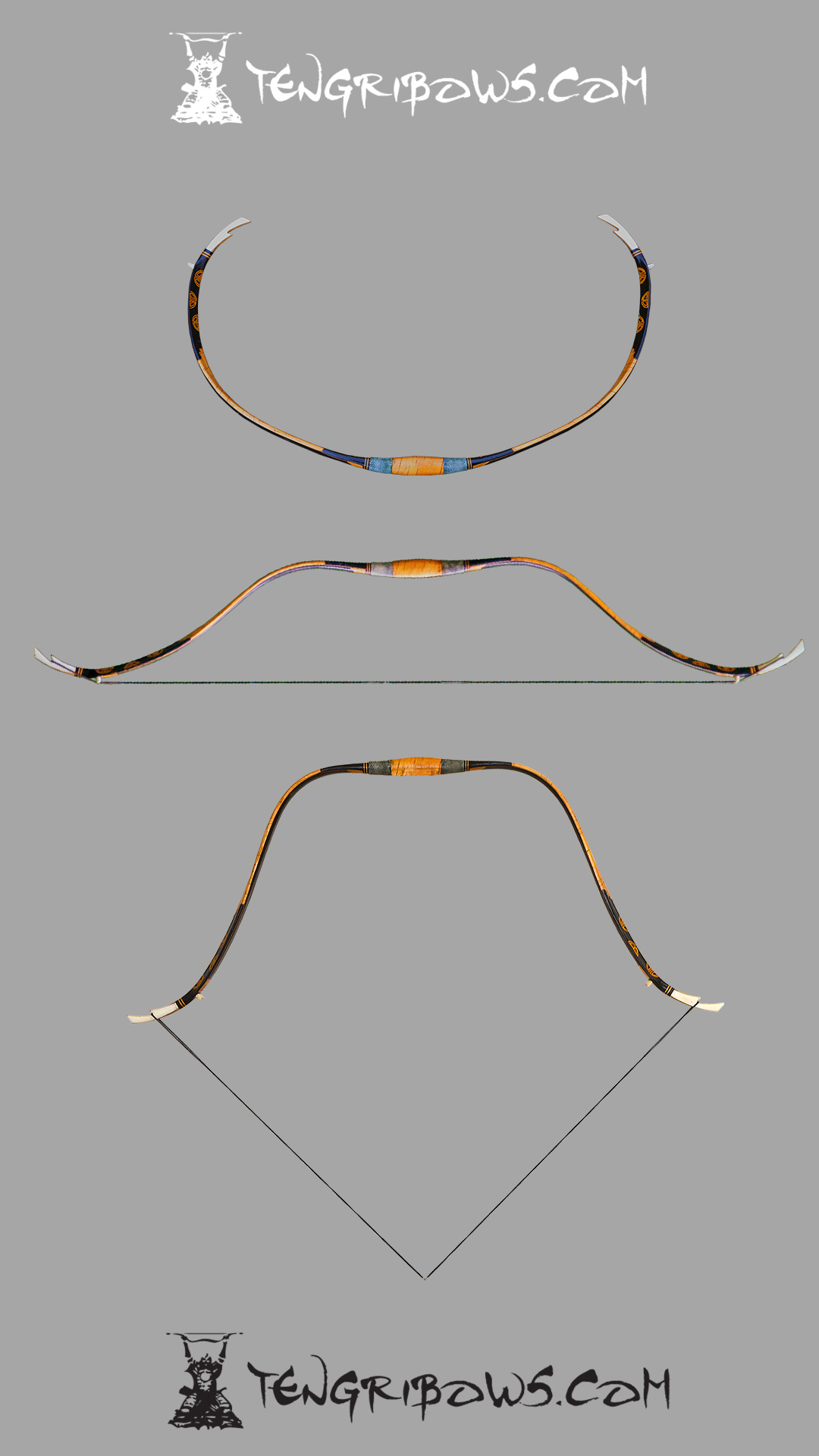
The small size of these bows made them perfect for horseback archery. Their unique attributes stem from the bow’s shape and the materials used in its construction. When unstrung, the bow reveals its greatest advantage: a large preload reflex. This means the bow is pre-strained in a “C” shape, opposite of what one might expect. The bow typically consists of a short bending section (Turkish Sal), a rigid handle, and inflexible ends (Turkish Bash). More modern bows evolved with a semi-bending part (Turkish Kassan), which is a transition between the flexible and inflexible sections.
The short limbs that allow for such a significant bend without cracking are constructed from three materials: horn on the side facing the shooter, wood in the center, and tendons on the outer side. Each material serves a specific purpose: the horn withstands high pressure, the tendons resist tension, and the wood provides the structure, preventing twisting and forming the bow’s skeleton. The wood is bent over steam into a reflex shape, and everything is glued together with fish or hide glue.
The production of such a bow takes about one year, including all necessary seasoning periods. Compared to all wood bows, this process is significantly more complex and time intensive. You can find my composite bow making videos here: http://tengribows.com/hornbow-tutorial
From a user’s perspective, a reflex bow made from traditional materials requires more care than longbows or modern variants. The archer must know how to correctly string the bow, ensure it remains aligned during stringing, and achieve an even bend in both limbs. New bows, in particular, are prone to twisting off limbs due to their reflex. And they need special care in the beginning. Additionally, natural materials and adhesives are sensitive to temperature and humidity.
You can find more details in the section below Composite bow Maintenance.
You can find photos of my bows at http://www.tengribows.com/bows-and-quivers and if you want to order one the best way is to send me an email.
These bows continue to hold a proud place in the world of historical archery, remaining immensely popular among enthusiasts.
Composite Bow Maintenance
Because a hornbow is organic, it behaves like a living organism. The first three months are critical, because the bow forms permanent habits in alignment and bend. Regular shooting and immediate correction of small misalignments teach the bow to stay straight. If the bow hangs unused, it develops twist or limb imbalance, and these faults become permanent. In this early period, it should be braced frequently, two to three times per week. Shooting every time is not necessary: warming the limbs, stringing the bow, correcting twist, balancing limb bend, and drawing the bow at home is enough.
This early training cannot be done by the bowyer. It must be done by the archer who owns and shoots the bow.
The bow can stay strung for long periods, days or weeks, but only if alignment is regularly checked.
A traditional composite bow is sensitive to twist, because its limbs are narrow, reflexed, and built to take force in one direction. Even small asymmetry in materials or in stringing can make a limb rotate, and a twisted limb can cause the string to slip. Corrections must be done immediately.
Before stringing, if the bow is fresh (first three months) or was unstrung for a long time and the string follow disappeared, warm up the limbs by gently bending them over your knees. The limbs need to become slightly “tired”, curved, which makes stringing easier and reduces the risk of damage. The safest method of stringing is over the knees with two people, because both limbs bend evenly.
Right after stringing, there is a five minute window to set the shape. First check the tiller. Both limbs should bend evenly or almost evenly. The limbs are not equally strong, the stiffer limb is supposed to be oriented on the bottom. If one limb bends much more than the other, bend the straighter (stiffer) limb over the knee and hold for about thirty seconds.
Then check alignment. Look from the back along the limbs toward each ear. I also use a method to check the bow along the string from the belly side. If an ear is twisted, bend it slowly the opposite way and hold. Repeat small corrections until it settles.
Before shooting, let the strung bow stand for a few minutes. After longer storage, give it about half an hour in the strung state.
Moisture alone is not a problem, but heat combined with moisture can soften glue. Keep the bow out of direct sun.
Good maintenance means correct stringing, frequent inspection, and immediate correction of twist and brace balance. In the first three months, these habits become permanent, and regular care keeps the bow straight and safe for many years.
This video demonstrates how to warm up and string a hornbow, and how to correct twist and balance limb bend.
About Hornbows
Asian composite bows, also known as reflex bows, horsebows, and hornbows, come with many names and forms. However, their fundamental construction and function are unified by a unique and fascinating principle.
Who used these bows? Why are they different from other types of bows? How are they made?
The most famous and skilled archers of these bows were the Turkic and Mongol tribes led by the mighty Genghis Khan. For them, the rider, bow, and horse were inseparable. Bows based on the same design were also used by various cultures, including the Turks, Arabs, Persians, Mughals, Koreans, Chinese, Manchu, Egyptians, Scythians, Assyrians, and Huns. These bows were used from antiquity into the late Middle Ages, spanning a vast area from Eastern Europe to East Asia, including North Africa and India. They were eventually replaced by firearms.
Compared to other bows, such as the famous English longbow, these composite bows were much smaller and lighter, yet they offered the same draw length and force. Moreover, the speed at which the arrow was released surpassed that of the all-wood longbows used in England.
The small size of these bows made them perfect for horseback archery. Their unique attributes stem from the bow’s shape and the materials used in its construction. When unstrung, the bow reveals its greatest advantage: a large preload reflex. This means the bow is pre-strained in a “C” shape, opposite of what one might expect. The bow typically consists of a short bending section (Turkish Sal), a rigid handle, and inflexible ends (Turkish Bash). More modern bows evolved with a semi-bending part (Turkish Kassan), which is a transition between the flexible and inflexible sections.
The short limbs that allow for such a significant bend without cracking are constructed from three materials: horn on the side facing the shooter, wood in the center, and tendons on the outer side. Each material serves a specific purpose: the horn withstands high pressure, the tendons resist tension, and the wood provides the structure, preventing twisting and forming the bow’s skeleton. The wood is bent over steam into a reflex shape, and everything is glued together with fish or hide glue.
The production of such a bow takes about one year, including all necessary seasoning periods. Compared to all wood bows, this process is significantly more complex and time intensive. You can find my composite bow making videos here: http://tengribows.com/hornbow-tutorial
From a user’s perspective, a reflex bow made from traditional materials requires more care than longbows or modern variants. The archer must know how to correctly string the bow, ensure it remains aligned during stringing, and achieve an even bend in both limbs. New bows, in particular, are prone to twisting off limbs due to their reflex. And they need special care in the beginning. Additionally, natural materials and adhesives are sensitive to temperature and humidity.
You can find more details in the section below Composite bow Maintenance.
You can find photos of my bows at http://www.tengribows.com/bows-and-quivers and if you want to order one the best way is to send me an email.
These bows continue to hold a proud place in the world of historical archery, remaining immensely popular among enthusiasts.
Composite Bow Maintenance
Because a hornbow is organic, it behaves like a living organism. The first three months are critical, because the bow forms permanent habits in alignment and bend. Regular shooting and immediate correction of small misalignments teach the bow to stay straight. If the bow hangs unused, it develops twist or limb imbalance, and these faults become permanent. In this early period, it should be braced frequently, two to three times per week. Shooting every time is not necessary: warming the limbs, stringing the bow, correcting twist, balancing limb bend, and drawing the bow at home is enough.
This early training cannot be done by the bowyer. It must be done by the archer who owns and shoots the bow.
The bow can stay strung for long periods, days or weeks, but only if alignment is regularly checked.
A traditional composite bow is sensitive to twist, because its limbs are narrow, reflexed, and built to take force in one direction. Even small asymmetry in materials or in stringing can make a limb rotate, and a twisted limb can cause the string to slip. Corrections must be done immediately.
Before stringing, if the bow is fresh (first three months) or was unstrung for a long time and the string follow disappeared, warm up the limbs by gently bending them over your knees. The limbs need to become slightly “tired”, curved, which makes stringing easier and reduces the risk of damage. The safest method of stringing is over the knees with two people, because both limbs bend evenly.
Right after stringing, there is a five minute window to set the shape. First check the tiller. Both limbs should bend evenly or almost evenly. The limbs are not equally strong, the stiffer limb is supposed to be oriented on the bottom. If one limb bends much more than the other, bend the straighter (stiffer) limb over the knee and hold for about thirty seconds.
Then check alignment. Look from the back along the limbs toward each ear. I also use a method to check the bow along the string from the belly side. If an ear is twisted, bend it slowly the opposite way and hold. Repeat small corrections until it settles.
Before shooting, let the strung bow stand for a few minutes. After longer storage, give it about half an hour in the strung state.
Moisture alone is not a problem, but heat combined with moisture can soften glue. Keep the bow out of direct sun.
Good maintenance means correct stringing, frequent inspection, and immediate correction of twist and brace balance. In the first three months, these habits become permanent, and regular care keeps the bow straight and safe for many years.
This video demonstrates how to warm up and string a hornbow, and how to correct twist and balance limb bend.